Guide
Integration
cui_app is optional. The core of CUI is a pure library: you give it input and a viewport size, it gives you vertices. That makes it easy to put CUI inside a game engine, an existing app or a custom window, on any graphics API.
The core loop
#include <cui/cui.h>
#include <cui/cui_render.h>

cui_gl_renderer *gl = cui_gl_create(get_proc_address);          /* after your GL context is current */
cui_ctx *ui = cui_create(&(cui_ctx_desc){ .renderer = cui_gl_iface(gl) });

for (;;) {
    /* 1. forward input from your window system */
    cui_input_mouse_move(ui, mouse_x_points, mouse_y_points);
    cui_input_mouse_button(ui, CUI_MOUSE_LEFT, down);
    cui_input_scroll(ui, 0, wheel_lines);
    cui_input_key(ui, CUI_KEY_ENTER, pressed, mods);
    cui_input_text(ui, utf8_from_ime);

    /* 2. build the UI */
    cui_set_viewport(ui, width_points, height_points, pixels_per_point);
    cui_begin_frame(ui, seconds_since_last_frame);
    my_ui(ui);
    cui_end_frame(ui);

    /* 3. render */
    cui_gl_render(gl, cui_get_draw_data(ui), false);   /* false: draw over your scene */
    swap_buffers();

    /* 4. sleep until something happens (optional) */
    if (!cui_needs_redraw(ui)) wait_for_events(cui_next_wakeup(ui));   /* seconds, or -1 for no timer */
}
Coordinates are in points (logical pixels). pixels_per_point is 2 on a typical retina screen. Input events can arrive at any time between frames; CUI collects them for the next frame.
An idle CUI app costs nothing: with no input and nothing animating, cui_needs_redraw is false and the loop sleeps. Components that blink or wait (the caret, tooltips, toasts) set cui_next_wakeup. When your own content changes on a timer, such as a clock, a poll or messages arriving, call cui_request_wakeup(ui, seconds) during the frame. The loop then wakes for it instead of redrawing continuously. cui_request_redraw asks for the next frame right away, for things that change every frame.
Input reference
| Function | Notes |
|---|---|
cui_input_mouse_move(ui, x, y) | Points, relative to the viewport |
cui_input_mouse_button(ui, button, down) | CUI_MOUSE_LEFT, RIGHT, MIDDLE |
cui_input_mouse_leave(ui) | The pointer left the window |
cui_input_scroll(ui, dx, dy) | In lines. Positive dy is the wheel moving up, toward the top of the content. Trackpads: pixels / 44 |
cui_input_key(ui, key, down, mods) | CUI_KEY_* and CUI_MOD_SHIFT, CTRL, ALT, SUPER. Send key repeats as additional presses |
cui_input_text(ui, utf8) | Typed characters after keyboard layout and IME processing |
cui_input_focus(ui, focused) | Window focus changes |
Platform services
cui_set_platform(ui, &(cui_platform_iface){
    .user = my_window,
    .set_clipboard = my_set_clipboard,           /* (void *user, const char *utf8) */
    .get_clipboard = my_get_clipboard,           /* returns a string valid until the next call */
    .set_cursor = my_set_cursor,                 /* CUI_CURSOR_ARROW, HAND, TEXT, RESIZE_EW... */
    .set_text_input_rect = my_set_ime_rect,      /* where the IME candidate window should go */
});
Useful queries for your app: cui_wants_keyboard (a text field has focus), cui_wants_mouse (the pointer is over the UI), cui_get_cursor.
Using the built-in backends with your loop
The SDL2 and GLFW backends are complete cui_app implementations (-DCUI_PLATFORM=sdl2 or glfw). Read src/platform/cui_app_sdl2.c for a compact, real example of the integration above: about 250 lines including the key map.
Renderers
OpenGL
cui_gl_create(loader) works with OpenGL 3.3 core and OpenGL ES 3.0 contexts (detected automatically). No GL headers or loader library are needed; pass SDL_GL_GetProcAddress, glfwGetProcAddress, wglGetProcAddress or similar. It returns NULL when the context is too old.
cui_gl_render sets its own blend, scissor and viewport state and leaves depth testing and face culling off. Restore your state afterwards if your renderer relies on it.
Software
cui_sw_renderer *sw = cui_sw_create();
cui_ctx *ui = cui_create(&(cui_ctx_desc){ .renderer = cui_sw_iface(sw) });
...
cui_sw_render(sw, cui_get_draw_data(ui), pixels, width, height, stride_bytes, CUI_SW_BGRA);
Renders into any 32 bit buffer, using several threads. Output matches the GPU renderer to within a fraction of a percent. Great for servers, tests, thumbnails and embedded framebuffers. cui_write_png saves a buffer.
Your own renderer
You need two things:
- Textures. Implement the three callbacks in
cui_renderer_iface: create (R8 for the font atlas, RGBA8 for images), update a sub-rectangle, destroy. Return any nonzero handle. - One draw call per command. For each
cui_draw_cmdset the scissor rectangle toclip(pixels, top left origin), bindtexture(0 meansfont_atlas) and drawindex_countindices starting atindex_offsetas triangles. Blend with premultiplied alpha:src * 1 + dst * (1 - src_alpha).
The vertex format and the reference shader are in rendering.md. Porting them to Vulkan, Metal, Direct3D 11/12, WebGPU, sokol or bgfx is mostly syntax.
Threads
A cui_ctx is not thread safe; use it from one thread. You may create several contexts (for several windows) and use each from its own thread. The software renderer parallelizes internally.
Memory
All allocations go through cui_ctx_desc.allocator if you provide one. Per frame data lives in an arena that is reused, so a steady UI does not allocate. Component state is freed automatically a few seconds after the component disappears.
What a window costs
Most of what a process uses with the OpenGL renderer belongs to the graphics driver, not to CUI. Measured with examples/hello and examples/tracker (Release build, 6 seconds after start, three runs each, the same within 2%):
hello, resident (private) | tracker, resident (private) | |
|---|---|---|
| Linux, software renderer | 7.1 MB (4.5 MB) | 12.6 MB (9.9 MB) |
| Linux, OpenGL (Mesa llvmpipe) | 100 MB (59 MB) | 108 MB (63 MB) |
| Linux, a bare OpenGL 3.3 window that only clears, no CUI | 76 MB (33 MB) | |
| Windows 10, OpenGL (NVIDIA), reported in issue #9 | 66 MB (111 MB) | 74 MB (126 MB) |
| Windows 10, software renderer, same report | 19 MB (11 MB) |
The Linux machine has no GPU, so its OpenGL is Mesa's CPU rasterizer; on it CUI picks the software renderer by itself unless told otherwise (see Performance). The bare window shows the driver's own cost before anything is drawn. The rest of the OpenGL figure is mostly the driver compiling and keeping CUI's shader. CUI's part is small:
- the context, its state and buffers, with the five embedded fonts unpacked (about 180 KB): 1.6 to 2.3 MB for the example apps after an hour of use (Performance);
- the glyph atlas, 1 MB at first. It doubles as needed, up to 16 MB with very large or many text sizes, and compacts back when the text is gone;
- with OpenGL, one shader program, one copy of the atlas as an 8-bit texture (1 MB at first) and a vertex buffer the size of a frame's triangles (usually under 1 MB).
CUI keeps the CPU copy of the atlas because it grows and compacts the atlas there and the software renderer draws from it. That is 1 MB at first, small next to the driver.
Pick the software renderer (.renderer = CUI_RENDERER_SOFTWARE in cui_app_desc, or CUI_RENDERER=software) when memory matters more than GPU offload: tools that stay open all day, many windows, small machines. It redraws only the tiles that changed, so a steady app costs almost no CPU; Performance has the numbers. Keep OpenGL for large, busy windows on machines with a real GPU.
Binary size
CUI is built to stay small. Measured with GCC, -DCMAKE_BUILD_TYPE=MinSizeRel, stripped, x86-64:
| Size | |
|---|---|
| Whole library (about 190 components, both renderers, X11 backend, fonts) | about 1,050 KB |
| of which embedded fonts (Inter, Geist, Geist Mono, 168 Lucide icons) | 95 KB, compressed |
examples/hello on Linux, whole executable | about 250 KB |
examples/hello.exe on Windows (MinGW, linked with -flto), whole executable | about 300 KB |
examples/assistant, an AI chat app | about 350 KB |
examples/gallery, every component in use | about 1,010 KB |
What keeps it small:
- The library is compiled with one section per function, so the linker can drop everything your app never calls. Turn that on in your own executable for release builds:
-Wl,--gc-sections(GCC and Clang on Linux),-Wl,-dead_strip(macOS),/OPT:REF /OPT:ICF(MSVC). The examples already do. - MinGW: its linker cannot drop single functions (every function has an unwind record, and it keeps them all), so it keeps whole files. Release builds of CUI also carry link-time optimization data, so link your app with
-flto(or setCMAKE_INTERPROCEDURAL_OPTIMIZATION) and only what you call remains:assistant.exeis 420 KB that way and 740 KB without. Without-fltoeverything still links and works, only bigger. - Release builds on Linux and BSD leave out unwind tables (6 to 7% of an app; CUI is C and throws nothing).
-DCUI_KEEP_UNWIND_TABLES=ONkeeps them, for backtraces from release builds or C++ exceptions thrown through CUI callbacks. - The embedded fonts are stored as DEFLATE streams (about 48% smaller) and unpacked into memory once, when a context is created (about 1.5 ms).
- Parts only some apps use (color emoji, the file browser, the terminal, the image decoder) are reached only from their own components; the core never calls into those files directly, so even a linker that keeps whole files leaves them out of an app that does not use them.
- Image decoding covers PNG and JPEG only.
-DCUI_IMAGE_ALL_FORMATS=ONadds BMP, GIF and TGA.
Going smaller:
| Option | Saves |
|---|---|
-DCUI_DEFAULT_FONTS=OFF (load your own fonts with cui_font_load_file) | 95 KB plus the decoder |
-DCUI_STB_IMAGE=OFF (upload pixels yourself with cui_image_create) | about 24 KB |
-DCUI_WITH_APP=OFF (core only, for use inside your engine) | the window layer and dialogs |
From C++
The headers are extern "C" and compile as C++11 or later, so CUI links into a C++ program like any C library. One thing differs: the named-argument calls (cui_button(ui, "Save", .variant = ...)) and the block macros (cui_column(ui) { ... }) are C99 and are not defined in C++. Call the function behind each one instead: the _ex function with an options struct, and the _begin and _end pair.
#include <cui/cui.h>
#include <cui/cui_app.h>
static void frame(cui_ctx *ui, void *) {
cui_box page{};
page.pad = 24;
page.gap = 12;
cui_column_begin(ui, &page);
cui_heading(ui, "Welcome", 2);
static bool notify = true;
cui_switch_ex(ui, "Email me when a build fails", ¬ify, nullptr);
cui_button_opts save{};
save.variant = CUI_BUTTON_PRIMARY;
if (cui_button_ex(ui, "Save", &save)) { /* ... */ }
cui_box_end(ui);
}
int main() {
cui_app_desc desc{};
desc.title = "My app";
return cui_app_run(&desc, frame, nullptr);
}Pass nullptr for the options to take every default. With C++20 the struct can be written in place, close to the C form: cui_button_opts save{ .variant = CUI_BUTTON_PRIMARY }; (fields in the order the header declares them; GCC's -Wextra then warns about the fields you left out, which -Wno-missing-field-initializers turns off). Every component's page on the site names its _ex function and lists the struct's fields. CUI's own tests compile this example as C++ on every push (tests/cpp_compat.cpp).
Text in other languages
The date components show month and weekday names and a "Today" button. Give CUI a table to show them in another language; it keeps the pointer and reads it every frame, so switching language is one call, and passing NULL goes back to English. An entry you leave NULL stays English. Weeks start on Monday, as in every CUI calendar.
static const cui_strings es = {
    .month = { "enero", "febrero", "marzo", "abril", "mayo", "junio", "julio",
               "agosto", "septiembre", "octubre", "noviembre", "diciembre" },
    .month_short = { "ene", "feb", "mar", "abr", "may", "jun", "jul", "ago", "sept", "oct", "nov", "dic" },
    .weekday = { "lunes", "martes", "miércoles", "jueves", "viernes", "sábado", "domingo" },
    .weekday_short = { "lun", "mar", "mié", "jue", "vie", "sáb", "dom" },
    .weekday_min = { "lu", "ma", "mi", "ju", "vi", "sá", "do" },
    .today = "Hoy",
};
cui_set_strings(ui, &es);
The date picker, date range picker, calendar, month and week calendars, gantt, calendar heatmap and file browser read the table. A component option that names its own words (the month calendar's month_names, the tour's button labels) wins over it. The order of day, month and year in a date stays the English one for now, and the date range picker's preset names ("Last 7 days") are not in the table yet. The English names live in one small file that only these components link, so an app without them pays nothing.
Optional Arabic-script text shaping
Configure with -DCUI_TEXT_SHAPING=ON to enable experimental static Arabic-script shaping and Unicode bidi. It is off by default. The draw and measure paths share the shaped advances; labels, headings, buttons and cui_text need no API changes. Load a trusted Arabic-script font, such as Vazirmatn, and assign it to a font role or add it as a fallback. The embedded Latin fonts do not cover Persian.
Text inherits its resolved context/container direction. Explicit RTL/LTR set the paragraph base. AUTO finds the first strong character and neutral containers inherit. Direct drawing uses the context direction; AUTO/INHERIT use first-strong, default LTR. See reading direction. CUI resolves the Unicode embedding levels and visual run order. CUI's internal cui_shape.c reads OpenType substitutions and positioning directly from the loaded font bytes, including lam-alef, ZWNJ and ZWJ. It needs no additional library. Only strings containing RTL characters or bidi/join controls enter this path. Latin-only strings keep the original iterator, rasterization and optical tracking. Shaped strings use the font's natural advances without optical tracking, which would otherwise pull cursive joins apart.
Text fields keep their existing drawing, cursor and selection behavior. This option does not add RTL editing or IME. Shaped paragraphs wrap greedily at spaces using complete shaped candidate-line advances. They retain their paragraph levels and use UAX #9 line ordering for each resulting line. The Latin path retains its existing heading balancing and orphan adjustment. An overlong shaped word stays whole, like the browser's default overflow behavior. RTL ellipsis truncation remains experimental.
The C99 bidi implementation has no runtime dependency or allocator. It implements P2/P3, W1-W7, N0-N2 (including bracket pairing), I1/I2, L1/L2 and L4 character mirroring from UAX #9. Explicit embeddings, overrides and isolates are unsupported and treated as boundary neutrals. CUI substitutes mirrored characters before shaping. The internal cui_bidi.h separates paragraph resolution from line ordering: resolve the paragraph once, then order each line range without changing paragraph levels. The wrapper resolves each paragraph once and reuses those levels for every line. A context retains up to 64 paragraphs in least-recently-used order and up to 128 shaped line ranges per paragraph. Cached glyph positions are shared by measurement and drawing; loading fonts or changing font roles/fallbacks invalidates them. Atlas resets and viewport scale changes keep glyph positions in logical units valid. Each retained text also keeps its completed wrapping result for the most recent font, size and width, so repeated frames skip candidate-line measurements. Multiline measurement returns the widest newline-separated paragraph.
Unicode 17.0.0 tables are checked in. To regenerate, download extracted/DerivedBidiClass.txt, BidiBrackets.txt and BidiMirroring.txt from https://www.unicode.org/Public/17.0.0/ucd/ into a scratch UCD directory, then run python tools/gen_bidi.py UCD_DIRECTORY src/cui_bidi_data.h. The data files are not bundled. cui_bidi_conformance BidiCharacterTest.txt runs the separately downloaded Unicode 17 character tests, excluding cases containing explicit embeddings, overrides or isolates; levels and visual order must both match. cui_test_bidi checks paragraph context across line ranges, L1/L2 and mirroring.
The internal shaper and bidi sources compile only with this option. Shaping buffers use the CUI allocator. Font loading requires trusted fonts because stb_truetype does not validate untrusted downloaded font data. Script segmentation covers Arabic, Hebrew and Latin; other script tags currently fall back to Latin.
The internal shaper implements Arabic joining, canonical Arabic composition and mark ordering, GSUB single/multiple/alternate/ligature/context/chained-context/ extension lookups, and GPOS single/pair/mark-to-base/mark-to-ligature/mark-to-mark/ context/chained-context/extension lookups. It uses the font's default language system. It does not implement variable-font positioning, device corrections, cursive attachment, reverse-chained substitutions or Arabic presentation-form fallback for fonts without OpenType Arabic features. Context and ligature rules are limited to 256 input glyphs. This remains an experimental subset of OpenType, not a claim of general HarfBuzz equivalence.
Regenerate the Unicode 17.0.0 tables with python tools/generate_joining.py. The script downloads Unicode data for generation; the data files are not vendored. For the test-only HarfBuzz oracle, install uharfbuzz in an isolated Python environment, build cui_shape_dump, then run:
python tools/compare_shape.py build/tests/Release/cui_shape_dump.exe path/to/Vazirmatn-Regular.ttf path/to/tahoma.ttf --output shape-results.json
python tools/check_shape_size.py build-off/examples/Release/hello.exe build-on/examples/Release/hello.exe
python tools/test_shape_size.py
MSVC x64 Release hello.exe must stay within 46,080 bytes of the fixed upstream OFF reference (282,112 bytes), so ON must not exceed 328,192 bytes. The size command prints both actual sizes and exits unsuccessfully above this ceiling. The fixed upstream reference is never replaced by the current OFF size.
The 220-line Persian corpus matches HarfBuzz 15.0.0 glyph IDs, advances and offsets with Vazirmatn Regular and Windows Tahoma. With the additional 441 mark-pair cases (--marks), all 661 glyph sequences match for both fonts. Tahoma positions match on all 661; six Vazirmatn cases differ by one font unit in one mark's horizontal offset. Exact positioning equivalence is therefore not yet achieved.
With tests enabled, cui_rtl is a headless visual probe. Pass an external trusted Vazirmatn-Regular.ttf and output PNG path. It checks lam-alef advance reduction, ZWNJ's effect, fallback measurement and the Persian glyphs in a mixed-script label. It renders Persian, mixed text, digits, punctuation and a wrapped paragraph:
cmake -S . -B build -DCUI_TEXT_SHAPING=ON
cmake --build build --config Release
build/tests/Release/cui_rtl path/to/Vazirmatn-Regular.ttf rtl.png
The font is not bundled. The ordinary CTest suite needs no external font.
cui_rtl_paragraph FONT.ttf OUT_PREFIX checks forced-container direction and shaped wrapping and captures the mixed Persian paragraph at 240, 360 and 600 px. Append bench for 200 measured build/layout/draw-list frames after 30 warm-up frames, excluding rasterization. It also benchmarks two copies joined into one 156-word Persian paragraph. It fails if either Persian average exceeds 0.25 ms. This measures cached steady-state frames, not cold-frame latency. Add any fourth argument to cui_rtl for dark images.
The following fixture is rendered by cui_rtl with shaping OFF and ON:
| Before | After | |
|---|---|---|
| Light | 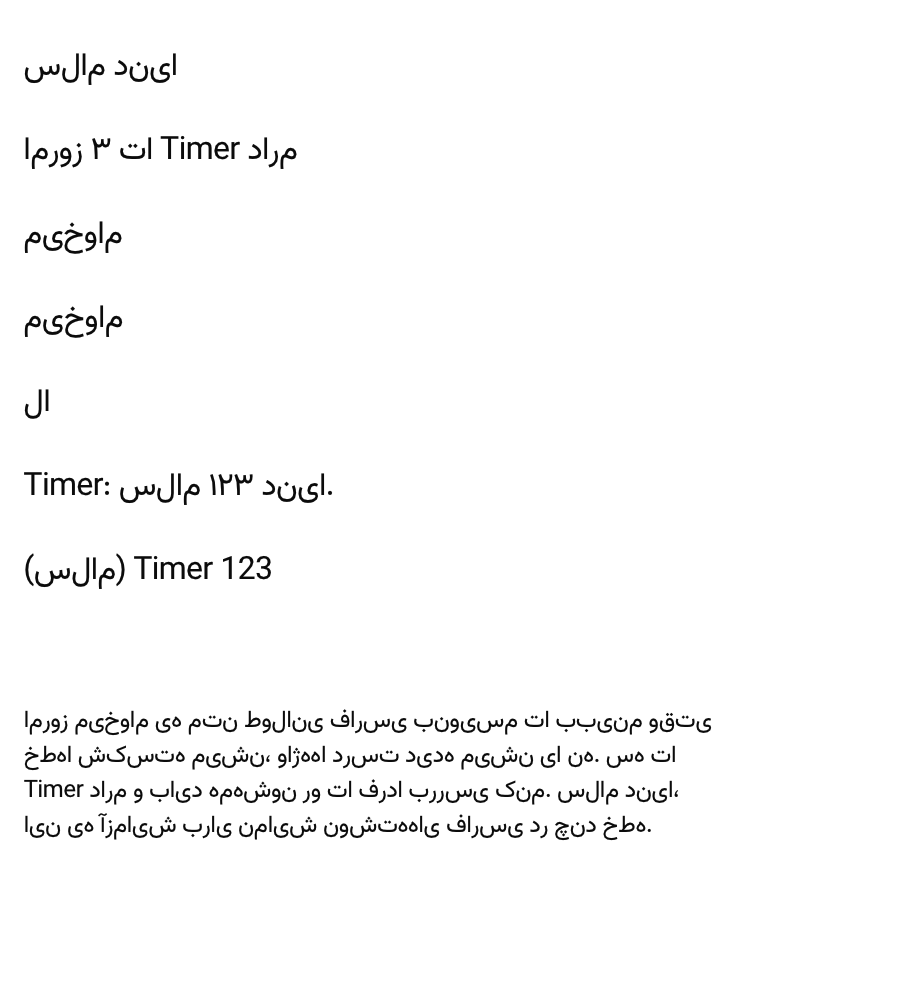 | 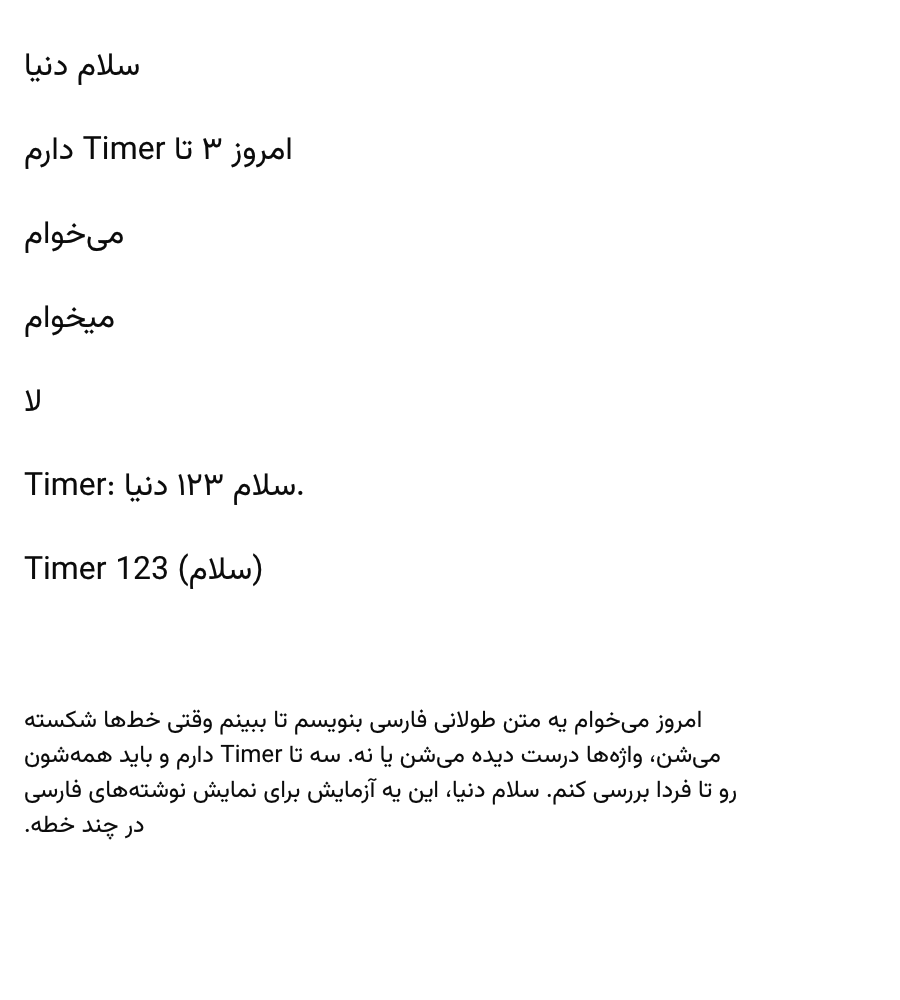 |
| Dark | 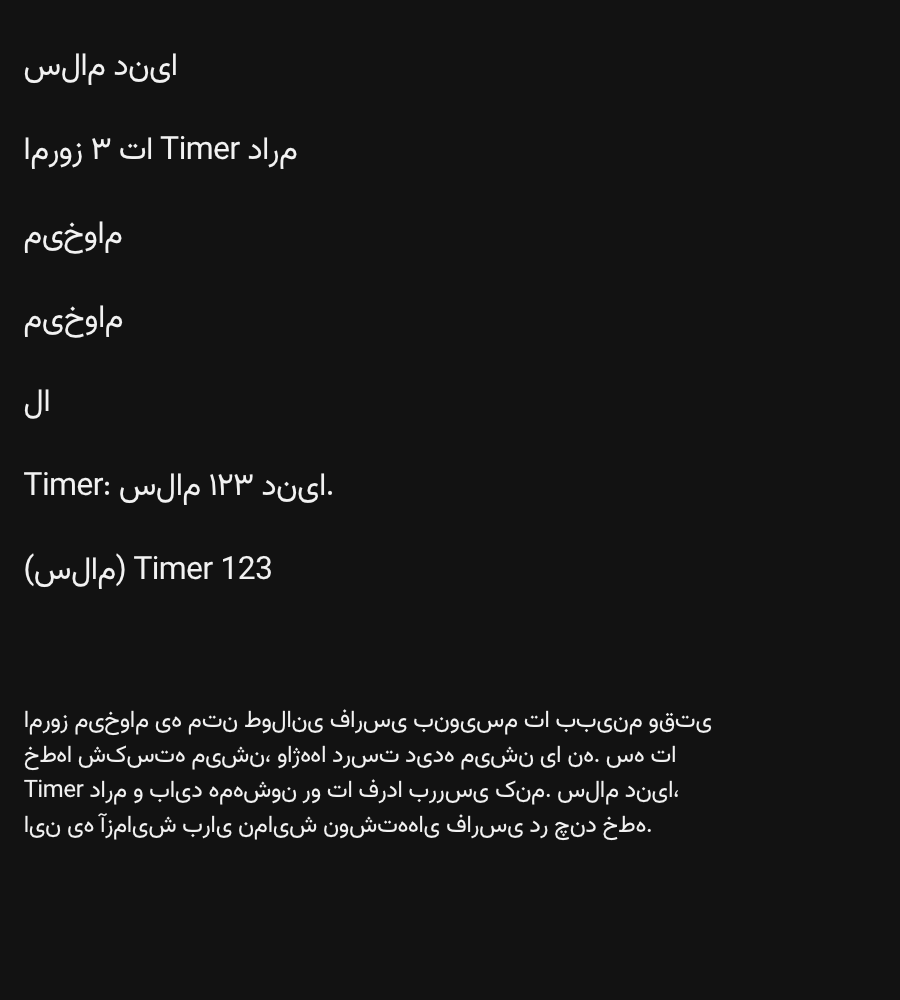 | 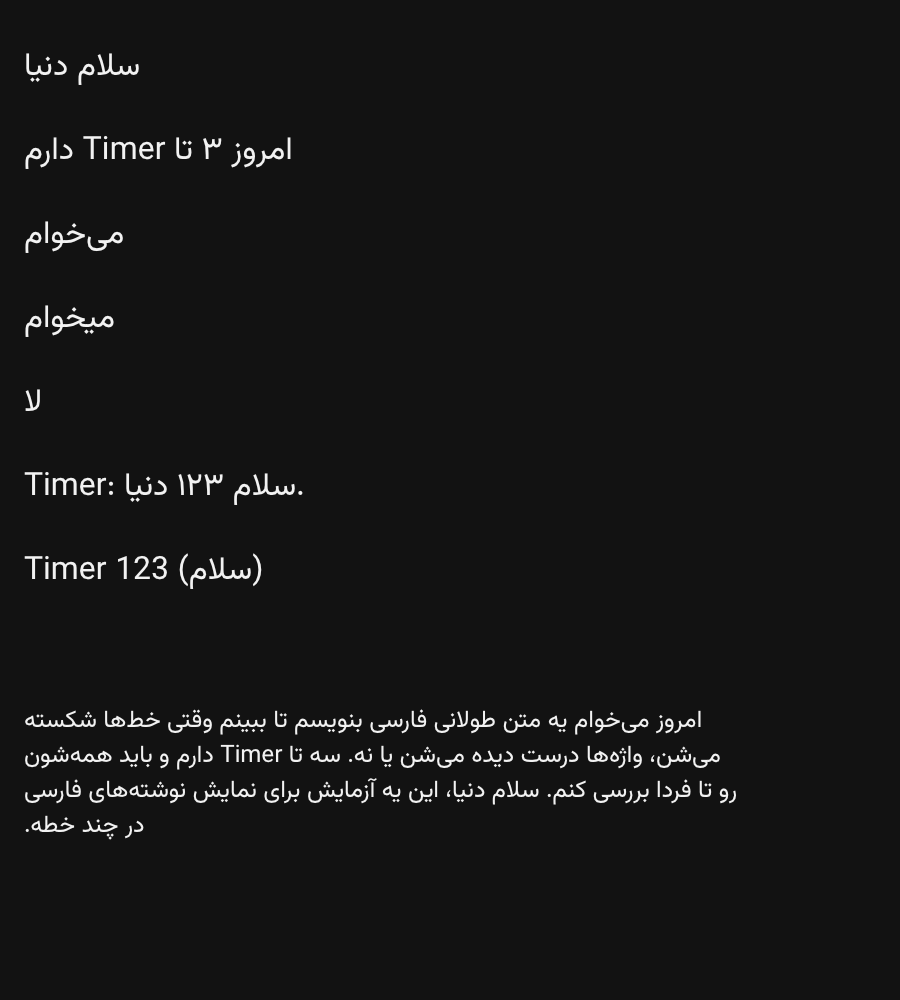 |